
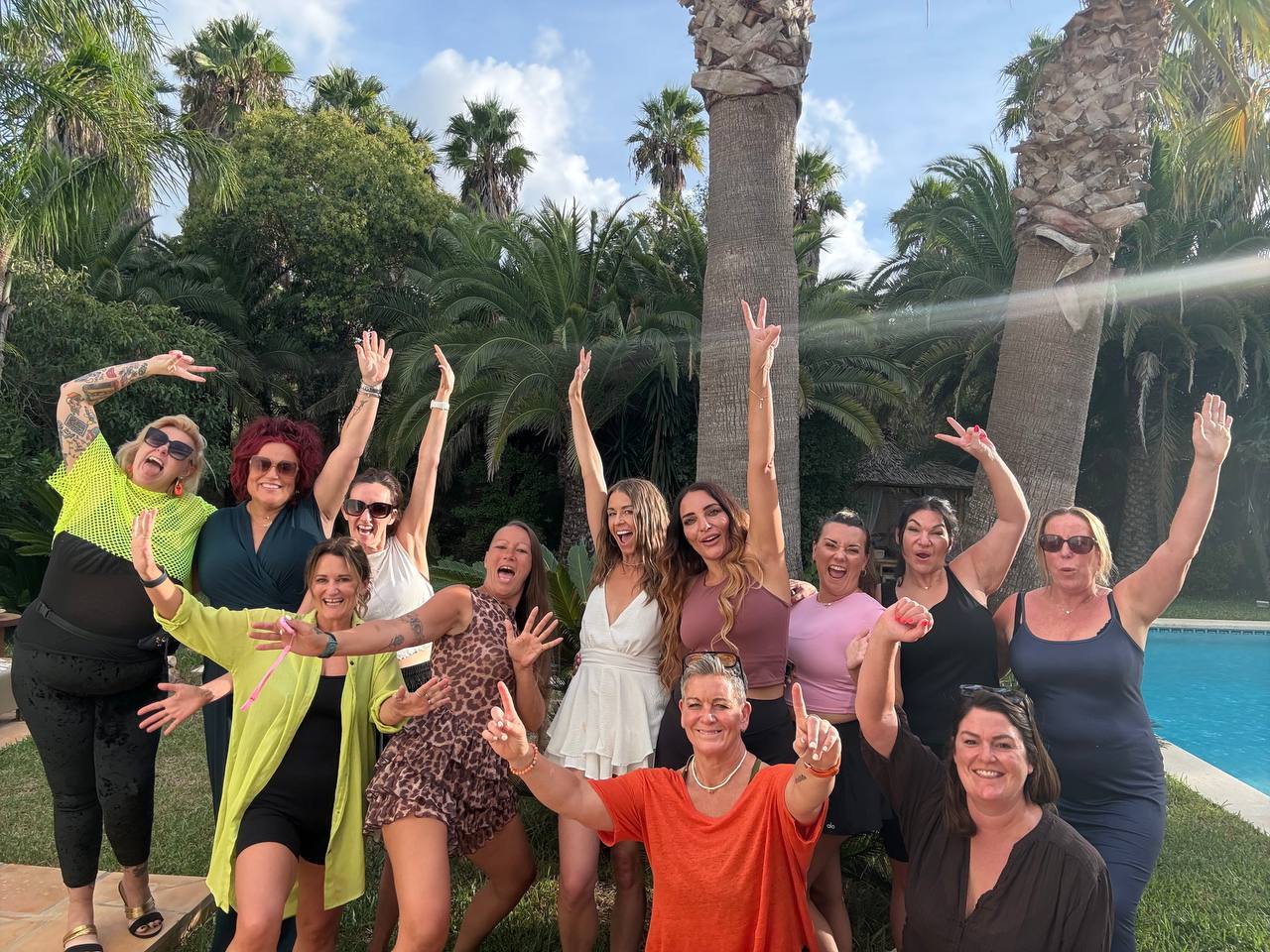
There’s a question I haven’t been able to stop thinking about since I came home from an Ibiza retreat last week:
Do you actually belong… or have you just got really good at fitting in?
Because I really don’t think they’re the same thing.
In fact, I’m starting to think that many of us have spent huge parts of our lives believing we’re looking for belonging, when what we’ve actually become incredibly good at is reading the room.
Who’s who?
What’s the energy?
What gets rewarded here?
What doesn’t?
Which version of me works in this room?
And then, often without consciously deciding to, we adjust.
Maybe we become slightly quieter or more impressive. More agreeable. More useful. Less ambitious. Funnier. Easier. Stronger.
Whatever version of us seems most likely to secure our place.
And then we call that connection.
But I believe that there’s a massive difference between being included, fitting in and genuinely belonging.
Belonging vs fitting in: what’s the difference?
Being included means somebody opened the door. You got the invitation. You’re in the room. You’ve got a seat at the table.
Fitting in means you’ve learned how to behave once you’re there.
You understand the codes. You know what’s expected. You’ve worked out which parts of yourself work in that environment.
But belonging?
I think belonging is something different again.
Belonging is being able to stay connected to yourself while you’re connected to other people.
Because if connection with other people requires disconnection from ourselves, that isn’t really belonging is it?
It’s just an adaptation.
And adaptation isn’t inherently bad. We all behave differently depending on context. I’m probably not turning up to a funeral in quite the same way I’d turn up to dinner in Ibiza after a brilliant day with business buddies.
But there’s a world of difference between adapting our behaviour appropriately and editing our identity to secure our place.
And that edit can start much earlier than we realise.
Who did you learn to be to belong?
Long before we consciously think about identity, we’re gathering information about who it’s safe and useful to be.
We learn:
This version of me gets praised.
This version gets attention.
This version doesn’t cause trouble.
This version makes people laugh.
This version succeeds.
This version gets loved.
This version is safe.
So we practise it.
We become capable.
The good one.
The achiever.
The funny one.
The helper.
The peacemaker.
The strong one.
The person who never needs anything.
The person who always knows what to do.
And eventually something fascinating happens.
We stop experiencing that version of ourselves as something we learned to do and start experiencing it as who we are.
“That’s just my personality.”
But is it?
Or is some of it who you learned you needed to be to stay connected, accepted, successful or safe?
That question sits at the heart of my work with identity.
Connection to yourself changes where you belong
In my identity work, I talk about the Sovereign Self. For me, the Sovereign Self is about getting underneath the layers we’ve accumulated through experience, expectation and repetition.
The inherited beliefs.
The roles.
The conditioning.
The adaptations.
The identities that once worked incredibly well for us.
And asking:
What’s actually mine?
What do I believe?
What do I want?
What matters to me?
What are my standards?
What feels true when nobody else gets a vote?
Because I think our ability to experience genuine belonging externally is deeply connected to how connected we are internally.
If I don’t know myself, how do I know where I belong?
If I’m constantly presenting different versions of myself depending on who’s in front of me, how can anybody genuinely know me?
They might like me.
They might include me.
They might think I’m fucking fabulous.
And I can still leave feeling unseen.
Because somewhere underneath it all, I know: They didn’t actually meet me.
They met the edited version.
And there’s a loneliness in that which I don’t think we talk about enough.
You can be surrounded by people and still feel completely alone when nobody is connecting with the actual person underneath.
We edit ourselves in business too
This isn’t only about friendships, families or relationships. We do it in business all the bloody time.
We enter an industry and start looking around.
What’s everybody doing?
What does success look like here?
What are successful people selling?
How are they launching?
What are they charging?
What are they posting?
What words are they using?
What business model are they following?
There’s absolutely nothing wrong with learning from other people. I invest heavily in mentors. I deliberately put myself in rooms with people who know things I don’t.
But there’s a question I’ve been asking myself more and more:
At what point does learning from brilliant people subtly turn into abandoning your own knowing?
Everybody’s launching this way, so I should launch this way.
Everybody says recurring revenue is the answer, so I need recurring revenue.
Everybody’s doing masterclasses, so I need a masterclass.
Everybody in this room wants to scale in the same direction, so perhaps I should want that too.
And suddenly, making a different business decision doesn’t simply feel like choosing another strategy.
It can feel like risking your place in the group.
Sometimes we aren’t following the crowd because we’ve consciously decided they’re right.
We’re following because deviating from the crowd can feel like risking belonging.
That’s an identity issue.
Belonging shouldn’t require self-abandonment
The more connected I’ve become to myself, the more I’ve started noticing the times when I’m tempted to override my own knowing to follow somebody else’s.
Do I actually want this?
Do I believe this?
Is this mine?
Does this way of working feel like me?
Or am I looking sideways and assuming that because everybody else appears to be walking in one direction, that must be where I should go too?
Self-trust doesn’t mean deciding everybody else is wrong and you’re always right. God help us!
It means being able to hear other people’s wisdom without automatically replacing your own with it.
To learn without disappearing.
To connect without conforming.
To belong without abandoning yourself.
And perhaps that’s one of the greatest gifts of becoming more connected to your own identity:
The more connected you become to yourself, the less willing you are to purchase belonging with self-abandonment.
What Ibiza taught me about real belonging
This was the part I hadn’t expected from Ibiza. I’d gone there for a three-day business and identity retreat with Dr Tania King-Mohammad and a group of amazing women.
I expected deep identity work.
I expected conversations about business, money, growth and standards.
I expected my own shit to come up too, because despite being an Identity Designer, I regret to inform you that identity work is never bloody finished.
New level. New edge and all that.
What I hadn’t expected was how much I’d come home thinking about safety and belonging.
Something felt different in that room.
I didn’t feel I had to show up as a particular version of myself to stay there.
I could be ambitious AND uncertain.
I could know the answer AND not have a fucking clue.
I could be successful AND still need support.
I could be the Identity Designer AND still need somebody else to hold the mirror up to me.
And, as it turns out, I could also vomit in sequins!
Yes. That happened. I became ill on the Saturday evening and suddenly I wasn’t capable Sarah.
I wasn’t useful Sarah.
I wasn’t holding anything together.
I needed looking after.
And what surprised me wasn’t being ill.
It was realising that I still felt safe.
My place hadn’t changed because I wasn’t okay.
I didn’t have to pretend to be well.
I didn’t have to disappear because somebody had seen something less polished.
And I think there was something incredibly powerful in experiencing: I don’t lose my place here when I’m simply human.
Perhaps that’s belonging too?
Real belonging creates more individuality, not less
There’s another side to this conversation too. When we talk about “finding our people”, it can very quickly become another version of conformity.
Find your tribe.
Find people exactly like you.
Everybody agrees.
Everybody thinks the same way.
That isn’t what I mean by belonging.
Actually, I think genuine belonging should create more individuality, not less.
I don’t want to belong to a room because everybody agrees with me. I want to belong in rooms where disagreement doesn’t threaten connection.
Where your success doesn’t diminish mine.
Where my decision to do something differently isn’t interpreted as criticism of yours.
Where somebody can tell me they think I’m wrong and neither of us has to leave the WhatsApp group!
The safest room isn’t necessarily one where everybody thinks like you.
It’s one where you don’t fear losing your place when they don’t.
Because if belonging requires conformity, we’ve just created another set of rules to perform.
Sometimes outgrowing a room doesn’t mean anyone was wrong
As our identity changes, the places where we belong may change too.
Our values change.
Our standards change.
Our desires change.
We stop wanting some things.
We start wanting others.
And sometimes we realise we’ve been shrinking, performing or agreeing in a particular environment for much longer than we realised.
That doesn’t automatically make the other people bad.
They might be wonderful people.
They just might not be your people anymore.
Not every room we leave needs a villain.
Not every friendship we outgrow was toxic.
Not every mentor whose advice we choose not to follow was wrong.
Not every community that no longer fits us failed.
Sometimes we’ve simply changed.
Connection to ourselves allows us to recognise that without needing to make anybody else wrong.
Maybe we were never meant to reinvent alone
I came home from Ibiza with plenty of business ideas. Plenty of decisions.
Plenty to think about.
But what stayed with me most wasn’t a strategy.
It was connection.
Connection to ourselves.
Connection to other people.
And what becomes possible when we can have both at the same time.
Because perhaps rising together doesn’t mean everybody moving in the same direction.
Maybe rising together means creating enough safety for each person to move in their own.
To become more themselves, not more like everybody else in the room.
To celebrate somebody else’s ambition without needing to copy it.
To witness somebody else’s choice without questioning our own.
To share wisdom without demanding obedience.
To challenge each other without trying to control each other.
To say I see you.
Rather than I need you to be like me.
I don’t believe we were meant to reinvent alone.
But equally, we weren’t meant to lose ourselves in the crowd.
So perhaps the question isn’t just: Where do I belong?
Maybe there are some questions that need to come first.
Where am I editing myself to secure belonging?
Where am I agreeing because disagreement feels risky?
Where am I following the crowd because choosing differently might mean standing alone?
Where am I performing capable, easy-going, successful, strong, funny or useful because somewhere along the way I learned that was the price of admission?
And who are the people around whom I don’t have to do that?
Because I’m starting to think genuine belonging isn’t finding somewhere you’re allowed in.
It’s finding, and sometimes creating, somewhere you don’t have to edit yourself to stay.
And perhaps the deepest work isn’t simply finding your people. It’s knowing yourself well enough that when you find them… they actually get to meet you.
Listen to The Reinvention Era
I explore this conversation much more deeply in Episode 162 of The Reinvention Era: Do You Belong… Or Have You Just Got Really Good at Fitting In?
We talk identity, self-trust, belonging, business, Ibiza, the Sovereign Self and what happens when we stop editing ourselves to stay in the room.


0 Comments